
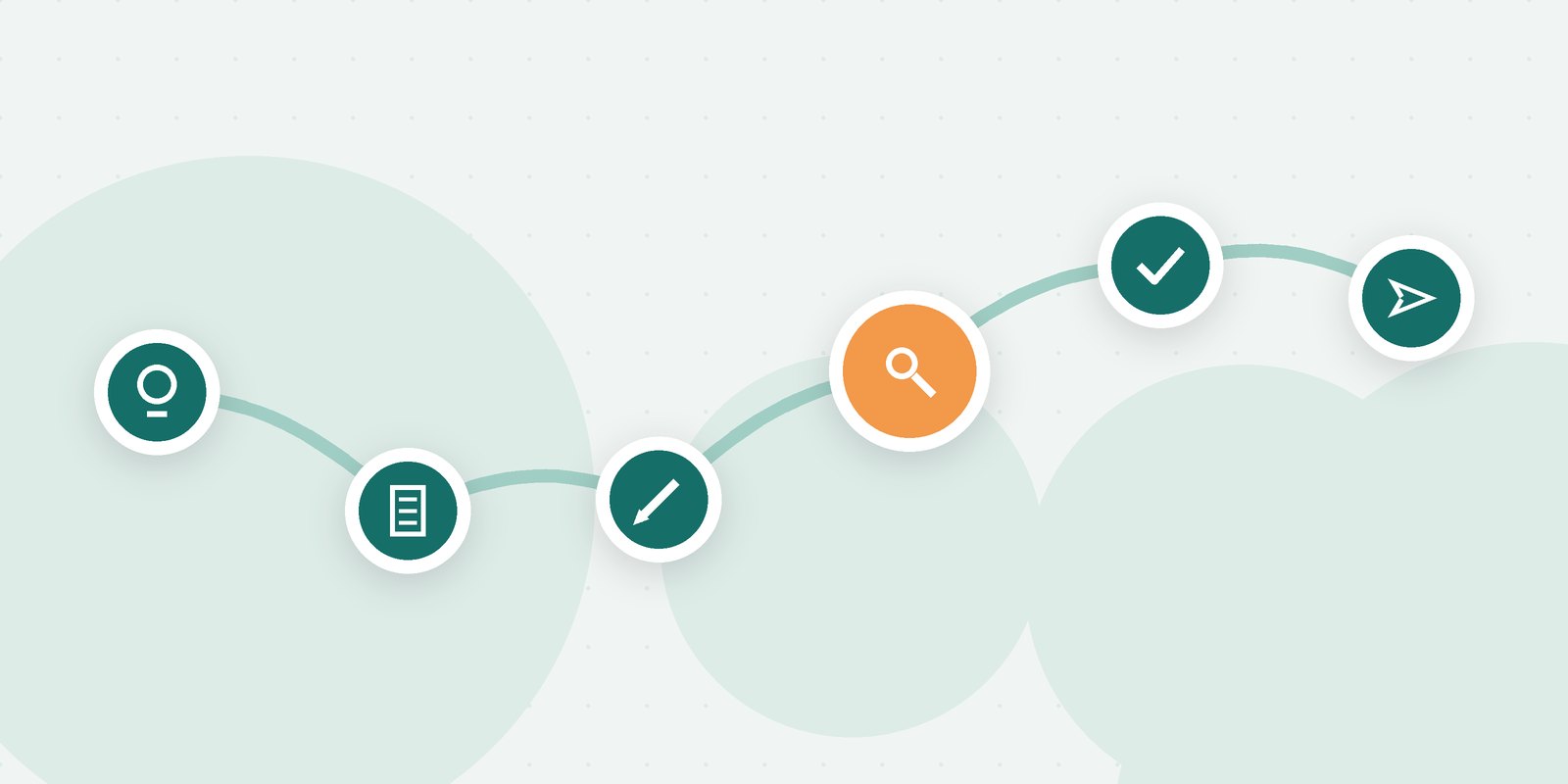
Most content teams can list their editorial workflow stages from memory: idea, draft, review, publish. Ask what has to be true before a piece leaves each stage, though, and the answers get vague. Is a draft "done" when the writer stops typing, or when it matches the brief? Is review finished when the editor leaves comments, or when those comments are resolved?
That vagueness is where delays come from. A stage name on its own does not tell anyone what to do. A stage with an owner, a clear input, a clear output and a simple exit rule does.
This guide walks through the stages a typical article passes through on its way from idea to publication, grouped into four phases. For each stage you will see who usually owns it, what it produces, and the signal that it is ready to move on. It goes one level deeper than the overview in what an editorial workflow is, which is the right place to start if the concept is new to you.
The Four Phases at a Glance
Nearly every editorial process, from a two-person startup blog to an enterprise content team, can be grouped into four phases:
- Plan: decide what to make and why.
- Create: turn the plan into a draft.
- Review: make the draft accurate, on brand and approved.
- Publish and learn: get it live, get it seen, and feed results back into planning.
Within those phases sit around eleven stages. Small teams merge several of them. Regulated teams split some of them further. The order, however, stays remarkably consistent.
Phase 1: Plan
Stage 1: Idea Intake
Owner: content lead or managing editor, with ideas coming from anyone.
What happens: Ideas are collected in one place: keyword research, customer questions, sales calls, product updates, competitor gaps and pitches from writers. Each idea is captured with a sentence on why it matters and who it is for.
Exit rule: the idea is written down in the shared backlog with a working title and a reason to exist. Ideas that live in someone's notes app have not entered the workflow yet.
Stage 2: Prioritisation
Owner: content lead, often with marketing or SEO input.
What happens: The backlog is ranked against goals. A useful filter is three questions: does this serve a real audience need, does it support a business goal, and can we do it better than what already exists?
Exit rule: the idea has a priority and a rough target date, or it has been explicitly parked. This is also the moment to plan it on the calendar. If your team is unsure where the calendar ends and the workflow begins, the comparison of an editorial calendar vs a content calendar is a helpful companion.
Stage 3: Brief
Owner: editor or content strategist.
What happens: The idea becomes something a writer can act on. A good brief includes the audience, the search intent or reader question, the angle, the primary keyword, a rough outline, sources or experts to use, internal links to include, length, deadline and who will review it.
Exit rule: a writer could start without asking a single clarifying question. If they would need a meeting first, the brief is not finished.
Phase 2: Create
Stage 4: Assignment
Owner: managing editor.
What happens: The brief is assigned to a writer, and every later stage gets a named owner at the same time: editor, specialist reviewers and final approver. Deadlines are set for the draft and for each review.
Exit rule: every stage from here to publication has a person's name next to it. "Marketing will review" is not a name.
Stage 5: Drafting
Owner: writer.
What happens: The writer researches, outlines and writes. In a healthy workflow the writer can flag blockers early, such as a missing expert interview or an unclear angle, instead of discovering them on deadline day.
Exit rule: the draft covers everything in the brief, includes the agreed links and sources, and the writer has read it through once for obvious errors. Handing over a half-finished draft "to get early feedback" should be a separate, explicit step, not a disguised submission.

Phase 3: Review
Stage 6: Editorial Review
Owner: editor.
What happens: This is often two passes. A structural edit checks whether the piece answers the brief, whether the argument holds together and whether anything important is missing. A line edit then tightens sentences, fixes tone and checks style.
Exit rule: feedback has been given in one place, the writer has revised, and the editor confirms the piece is ready for specialists. Feedback split across a document, a chat thread and an email is the single most common reason this stage drags on.
Stage 7: Specialist Reviews
Owner: SEO specialist, fact checker, subject matter expert, legal or compliance, depending on the piece.
What happens: Each specialist checks one thing. SEO checks the title, headings, metadata, internal links and whether the piece matches search intent. Google's own guidance on creating helpful, reliable, people-first content is a sensible checklist for this pass. Fact checkers verify claims and sources. Experts confirm accuracy. Legal checks claims, disclosures and anything that could create risk.
Exit rule: each specialist has signed off on their scope only. These reviews can usually run at the same time rather than one after another, which saves days on longer pieces.
Not every piece needs every specialist. Deciding which reviews apply belongs in the brief, not in a debate after the draft is written.
Stage 8: Approval
Owner: a single named approver, such as the managing editor, head of content or a client.
What happens: Approval is not another edit. The approver confirms the piece is ready to represent the brand and resolves any conflicts between reviewers.
Exit rule: a clear yes, recorded somewhere everyone can see. A thumbs up in a busy channel does not count. For teams with several stakeholders, a defined content approval workflow keeps this stage from becoming a committee.

Phase 4: Publish and Learn
Stage 9: Production
Owner: editor, designer or publisher.
What happens: The approved text becomes a finished page: images and alt text, formatting, headings, meta title and description, category, tags, author and any calls to action.
Exit rule: the article looks right in a preview on desktop and mobile, every link works, and the metadata is complete.
Stage 10: Scheduling and Publishing
Owner: publisher.
What happens: The piece is scheduled for its slot or published. Someone confirms it is live, indexed where it should be and appearing correctly on the blog and in feeds.
Exit rule: the live URL is checked by a human after publishing, not just assumed. Many teams have a story about a post that "published" with a broken image or the wrong canonical tag.
Stage 11: Distribution, Measurement and Refresh
Owner: content lead, marketing or SEO.
What happens: The article is shared through newsletters, social channels and sales teams, and internal links are added from older posts. After a few weeks, performance is reviewed: is it ranking, is it read, does it lead to signups? Pieces that underperform or age are scheduled for a refresh, which sends them back to Stage 3 as a new brief.
Exit rule: results are recorded and the next action is decided. This is the stage most teams skip, and it is the one that turns a workflow into a loop that improves over time.
Naming Stages So Status Is Obvious
Once your stages are defined, the names you show in your tool matter more than people expect. Status labels should describe where the piece is, not who to blame. "In editorial review" is clear. "Waiting on Sam" is not, because Sam might be on leave and nobody knows who covers.
A few practical rules help:
- Use one label for each stage and keep it the same across all content types.
- Separate "in progress" from "waiting." "Drafting" and "Draft submitted" tell you very different things.
- Keep the number of visible statuses small enough to fit on one screen.
- Make the owner a separate field from the status, so both are visible at once.
How Many Stages Do You Actually Need?
There is no correct number. A founder-led blog might run five stages: idea, brief, draft, founder review and publish. A regulated enterprise team might run fourteen. A useful test is to ask, for each stage, "what goes wrong if we remove this?" If nobody can answer, merge it with its neighbour.
The opposite test matters too. If the same problem keeps appearing in published content (factual errors, missing metadata, off-brand tone), a stage is probably missing or has no exit rule.
Once the stages are stable, the repetitive parts between them, such as notifying the next owner, moving status and sending reminders, are good candidates for editorial workflow automation. The judgement inside each stage should stay human.
Running the Stages Week to Week
Defining stages is the easy part. Keeping pieces moving through them, week after week, with several people involved, is the work of editorial workflow management. If you are setting up stages for the first time, the step-by-step guide on how to build an editorial workflow covers roles, approvals and calendars in more depth.
In Narranta, each of these stages can be set up as a step in your team's workspace, with the owner, reviewers and comments attached to the article itself. That makes it easy to see which stage every piece is in without asking anyone.
Frequently Asked Questions
What are the stages of an editorial workflow?
A typical editorial workflow has four phases: plan, create, review, and publish and learn. Within them sit stages such as idea intake, prioritisation, brief, assignment, drafting, editorial review, specialist reviews, approval, production, publishing and measurement.
What is the most important editorial workflow stage?
The brief has the biggest knock-on effect. A clear brief speeds up drafting, reduces revision rounds and makes review faster, because everyone is checking the piece against the same agreed goal.
What is the difference between editorial review and approval?
Editorial review improves the piece: structure, accuracy, tone and style. Approval confirms the finished piece is ready to publish and resolves conflicts between reviewers. They can be done by the same person, but they are different decisions.
Should SEO review happen before or after editing?
Most teams build SEO into the brief, then run a short SEO check after the editorial review, once the structure and headings are stable. Running SEO review on an early draft often means doing it twice.
How long should each stage take?
It depends on the piece, but every stage should have an expected time. Many teams aim for review stages measured in working days, not weeks, and track where pieces wait longest to decide what to fix first.
From Stage Names to a Process People Trust
Editorial workflow stages are only useful when everyone agrees what each one means. Give every stage an owner, an output and an exit rule, keep the labels simple, and close the loop with measurement so each round of content teaches you something.
If you would like your stages, owners and reviews to live in one place instead of across documents and chat threads, you can create your team's workspace in Narranta and set up your stages from day one.