

Growing a publication is exciting, but it also brings new operational challenges. What starts as a simple back and forth between one writer and one editor quickly turns into a collaborative effort involving multiple contributors, reviewers, marketers, and stakeholders.
Without a structured process, articles become hard to track. Deadlines slip, approvals take longer than they should, and team members end up spending more time chasing updates than actually creating content.
These problems rarely come down to a lack of talent. More often, they're the result of an editorial workflow that hasn't evolved alongside the publication.
An editorial workflow gives you the structure needed to manage content consistently, from the first idea all the way to publication. It defines who's responsible at every stage, sets clear approval processes, and gives everyone visibility into where each article stands.
Whether you run a company blog, a digital magazine, or a multi-author publication, building the right editorial workflow is one of the smartest investments you can make in your content operations.
In this guide, you'll learn how to build an editorial workflow that scales with your publication while improving collaboration, accountability, and publishing consistency.
Why Editorial Workflows Become Essential as Publications Grow
Small content teams often get by on informal communication. A writer finishes an article, sends it to an editor over email or chat, gets feedback, makes revisions, and hits publish. Because only a couple of people are involved, everyone just knows what needs to happen next.
As publications grow, though, that simplicity disappears.
A growing publication may involve:
- Multiple writers
- Editors
- SEO specialists
- Subject matter experts
- Marketing managers
- Legal or compliance reviewers
- Designers
- Publishers
Every additional contributor adds another handoff to the publishing process, and without a clearly defined workflow, those handoffs turn into opportunities for delays, duplicated work, and confusion.
Instead of asking "What should we publish next?", teams start asking things like: Who's reviewing this article? Has the editor approved these changes? Which version is the latest? Why wasn't this published yesterday?
When those questions become the norm, it's usually a sign the publication has outgrown its existing process.
Read more about content workflow bottlenecks.
What Is an Editorial Workflow?
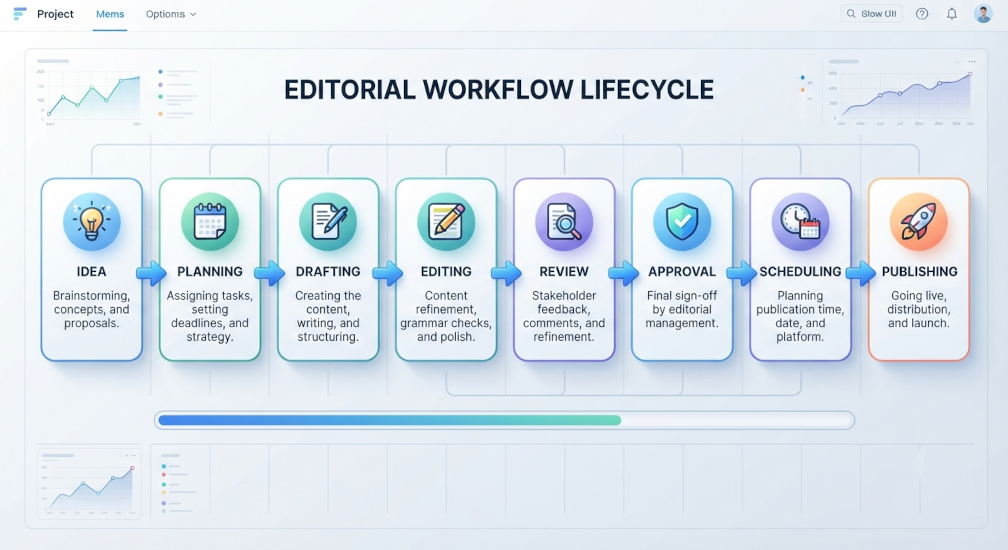
An editorial workflow is the repeatable process that takes content from an initial idea to publication. Rather than relying on individual memory or scattered conversations, it establishes a consistent sequence of stages that every article moves through.
A typical editorial workflow includes:
Stage | Purpose |
|---|---|
Idea | Capture content ideas and opportunities |
Planning | Research topics and define objectives |
Assignment | Assign the article to a writer |
Drafting | Create the initial content |
Editing | Improve quality, clarity, and structure |
Review | Collect stakeholder or expert feedback |
Approval | Final editorial sign-off |
Scheduling | Select a publication date |
Published | Make the article available to readers |
Every publication is different, but defining these stages creates consistency and takes a lot of the guesswork out of the process.
Characteristics of a Strong Editorial Workflow
Not every workflow is equally effective. The best editorial workflows make collaboration easier instead of adding unnecessary complexity. A few characteristics tend to separate the workflows that work from the ones that create bottlenecks.
Clear ownership. Every stage should have a clearly assigned owner. Writers create drafts, editors improve them, subject matter experts verify accuracy, and publishers schedule articles. When ownership is spelt out, everyone knows exactly when it's their turn to act.
Standardised processes. Publishing every article differently creates confusion. A standardised workflow makes sure every piece of content follows the same process, which makes deadlines easier to predict and quality easier to maintain. It also makes onboarding new team members much simpler, since expectations are already documented.
Visibility across the team. A healthy editorial workflow lets anyone involved answer three questions right away: What stage is this article in? Who's responsible for it? What happens next? If finding those answers means digging through emails or messaging platforms, the workflow is missing visibility.
Flexibility. Consistency matters, but workflows also need to adapt to different types of content. A short company announcement might only need a writer and an editor, while a research report could require multiple reviewers, legal approval, design input, and executive sign-off. Good workflows provide structure without becoming rigid.
Start with Your Publishing Goals
Many organisations build workflows around tools instead of objectives. It's better to start by asking what your publication is actually trying to achieve.
Your workflow should support goals like the following:
- Publishing consistently
- Improving content quality
- Reducing approval delays
- Increasing collaboration
- Scaling content production
- Maintaining brand consistency
Understanding these priorities helps you figure out which workflow stages are necessary and which ones just add unnecessary complexity. A fast-moving news publication might prioritise speed above everything else, while a healthcare organisation may need several compliance reviews before anything goes live. The workflow should reflect the needs of your publication, not a generic template.
Map the Complete Content Lifecycle
Once your publishing goals are clear, the next step is understanding how content actually moves through your organisation.
Many teams make the mistake of designing workflows based on assumptions rather than observing how content really flows, and that often leads to missing steps, duplicated stages, or unnecessary complexity. A better approach is to map the full lifecycle of a single article from start to finish.
In most growing publications, the journey looks something like this.
An idea is first captured during planning sessions or editorial meetings. It might come from keyword research, product updates, customer insights, or internal stakeholders. Once the idea gets approved, it moves into planning, where the topic is refined, the target audience is defined, and the purpose of the content is clarified. This is usually where teams decide whether the article is informational, commercial, or educational.
After planning, the article gets assigned to a writer. This handoff matters more than it seems, because unclear assignments are often the first bottleneck in the whole workflow.
The writer then creates a draft. This is usually the longest stage in the process and the one with the least visibility unless the workflow is properly structured.
Once the draft is done, it moves into editing. Here, editors focus on clarity, structure, tone, and consistency. In more mature teams, this stage may also include SEO review or content optimisation.
After editing, the content typically enters a review stage, where subject matter experts or stakeholders verify accuracy, particularly for technical or regulated industries.
Next comes approval, the final confirmation that the content meets all requirements and is ready to publish.
Finally, the article gets scheduled and published according to the content calendar.
Mapped out, the lifecycle looks like this:
- Idea
- Planning
- Assignment
- Drafting
- Editing
- Review
- Approval
- Scheduling
- Publishing
This sequence becomes the foundation of your editorial workflow. Every stage represents a clear handoff point where responsibility shifts from one role to another.
Without this kind of mapping, teams often skip steps, blur responsibilities, or lose visibility into where content is stuck. Once you've defined the lifecycle, document it and share it across the team so everyone understands how content moves through the system.
Assign Clear Roles and Responsibilities
A workflow only works when ownership is clearly defined. One of the most common reasons content gets delayed isn't that people are unproductive; it's that no one is entirely sure who's responsible for the next action.
As your publication grows, assigning clear roles becomes essential for maintaining speed and accountability. In a typical editorial setup, roles might look like this:
The content manager plans topics, manages the editorial calendar, and makes sure content aligns with overall strategy.
Writers produce drafts based on assigned topics and maintain quality standards.
Editors focus on improving clarity, structure, tone, and readability while making sure content meets editorial guidelines.
SEO specialists optimise content for search visibility, including keywords, metadata, and internal linking.
Subject matter experts review content for accuracy, especially for technical or industry-specific topics.
Managing editors oversee the entire workflow and make sure content moves smoothly from stage to stage.
Publishers schedule and release content according to the editorial calendar.
When roles are clearly defined, everyone knows exactly when their input is needed and what's expected of them. That cuts down on unnecessary back and forth and eliminates confusion about ownership. It also makes it easier to scale the team, since new contributors can slot into an existing structure instead of forcing the team to invent ad hoc processes on the fly.
Build a Clear Approval Process
As publications grow, approval becomes one of the biggest sources of delay in the entire editorial workflow. Without structure, content can sit in limbo for days or even weeks while everyone waits for someone to review it, and often no one is entirely sure who's actually responsible for the final call.
A strong approval process removes that ambiguity by clearly defining the following:
- Who can approve content
- At what stage approval happens
- What criteria must be met before approval
- What happens if changes are requested
In most editorial workflows, approval is the final gate before publication. In more complex organisations, though, there may be multiple approval layers depending on the content type. Marketing content might need brand approval. Technical content might need expert validation. Regulated industries might need legal review.
The key is to avoid piling on unnecessary approval stages. Every extra step adds to publishing time, so approvals should be intentional rather than automatic. A simple, effective approval structure often looks like this:
- Editor approval for quality and structure
- Subject matter approval for accuracy
- Final managing editor approval for publication readiness
Once approved, content moves straight to scheduling. The goal isn't to remove control; it's to create enough clarity that content never gets stuck without someone accountable for it.
Create an Editorial Calendar That Supports the Workflow
An editorial workflow can't function well without a system for planning what gets published and when, and that's where the editorial calendar comes in.
An editorial calendar isn't just a schedule. It's a visual picture of your content strategy in action. It lets teams:
- Plan upcoming content
- Balance workloads across writers
- Align content with campaigns or product launches
- Prevent publishing gaps
- Track deadlines across multiple contributors
A common mistake is treating the editorial calendar as something separate from the workflow itself, when really the two should be tightly connected. Every item on the editorial calendar should have a defined workflow stage, an assigned owner, a due date, and a publishing date. Without that connection, the calendar becomes a passive planning tool instead of an active part of the publishing system.
A strong editorial calendar doesn't just show what will be published. It shows the status of everything currently in production.
Standardize Communication Across the Team

Communication breakdown is one of the most overlooked causes of workflow inefficiency. As teams grow, conversations about content get scattered across email, chat platforms, documents, and meetings, and that fragmentation leads to lost feedback, duplicate comments, conflicting instructions, and delayed decisions.
A structured editorial workflow solves this by centralising communication around the content itself. Instead of discussing articles across separate channels, feedback should live where the content lives. That way, editors can see the full context of feedback, writers don't miss important comments, revisions stay clearly tracked, and everyone stays aligned on the latest version.
Standardising communication also means agreeing on how feedback should be given. Comments should be specific and actionable, requests should be tied to workflow stages, and decisions should be recorded in the system rather than buried in a chat thread. When communication is structured this way, the whole workflow becomes much easier to manage.
Measure and Improve Your Editorial Workflow
A workflow isn't something you build once and forget. It's a system that should evolve over time, and improving it requires visibility into how content moves through each stage.
Key metrics worth tracking include:
- Time to publish
- Time spent in each stage
- Number of revisions per article
- Approval delays
- Missed deadlines
- Content throughput per month
These metrics help you spot where bottlenecks are forming. If content consistently spends too much time in review, that might point to unclear expectations or overloaded reviewers. If approval is slow, it might mean there are too many decision-makers or the criteria aren't clear enough. By continuously analysing workflow performance, teams can make small, steady improvements that add up to a much more efficient process over time.
Common Mistakes When Building an Editorial Workflow
Even well-organised teams make mistakes when designing editorial workflows. Some of the most common ones include:
Overcomplicating the process. Adding too many stages or rules slows down publishing instead of improving it.
Lack of ownership. When responsibilities are unclear, content gets stuck between stages.
Ignoring adoption. A workflow that's too complex won't be followed consistently by the team.
Treating tools as the workflow. Software should support the workflow, not define it.
Failing to iterate. Workflows need to evolve as the team grows and content needs change.
Avoiding these mistakes matters just as much as designing the workflow in the first place.
How Narranta Supports Editorial Workflows
As content operations scale, managing workflows manually becomes harder and harder. Narranta is built to help teams manage the entire editorial lifecycle in one place.
With Narranta, teams can:
- Define clear workflow stages
- Assign roles and responsibilities
- Track content from idea to publication
- Manage approvals in one system
- Maintain editorial calendars
- Improve visibility across all content
Instead of juggling multiple tools for planning, writing, reviewing, and publishing, everything lives in a single workflow system built specifically for content teams. That reduces friction and lets teams spend more time producing content and less time managing it.
Bringing Everything Together
Building an editorial workflow isn't about adding complexity. It's about creating clarity.
Done well, a workflow makes sure everyone knows what they're responsible for, content moves smoothly through each stage, approval never becomes a bottleneck, and publishing becomes predictable and consistent.
The most effective editorial workflows aren't the most complex ones. They're the ones teams actually use every day without friction. As your publication grows, investing time in designing and refining your workflow becomes one of the most important decisions you can make for long-term content success.