

Creating high-quality content is only half the battle. Before an article ever reaches your audience, it usually has to pass through several rounds of review, revision, and sign-off. For small teams, that process can happen informally: a quick email here, a Slack message there. But as organisations grow, informal approvals stop being a convenience and start becoming one of the biggest obstacles to consistent publishing.
Articles sit waiting for feedback that never seems to arrive. Editors aren't sure whether a subject matter expert has actually reviewed the latest draft. Marketing asks for last-minute changes right before the piece is supposed to go live. And more often than not, deadlines get missed not because the writing wasn't ready, but because nobody was quite sure who owned the next step.
A structured content approval workflow fixes this by giving every piece of content a clear, repeatable path from draft to publication. It improves collaboration, removes bottlenecks, and makes sure every article meets your organisation's quality bar before it ever reaches a reader.
In this guide, we'll walk through what a content approval workflow actually is, why it matters, the bottlenecks that trip most teams up, and the best practices that help an approval process scale as your content operation grows.
What Is a Content Approval Workflow?
A content approval workflow is the structured process content follows once a draft is finished and before it's published. It defines who reviews the piece, in what order, what "approved" actually means, and what conditions have to be met before it can go live.
Every organisation shapes this a little differently, but most approval workflows share the same core cast of characters: writers who create the content, editors who sharpen its quality and readability, subject matter experts who verify accuracy, marketing teams who protect brand consistency, and publishers who prepare everything for release.
Think of the approval workflow as sitting inside the broader editorial workflow: it's the final quality checkpoint before content reaches an audience. Skip it, and you're gambling on publishing something inaccurate, off-brand, or simply misaligned with what the business actually needs.
If editorial workflows are new territory for you, it's worth starting with our guide on What Is an Editorial Workflow? A Practical Guide for Content Teams, which explains how approval fits into the bigger publishing picture.
Why Content Approval Workflows Matter
As a publishing team grows, so does the complexity of getting everyone on the same page. More contributors means more room for miscommunication, conflicting feedback, and decisions that stall out for no clear reason.
A structured approval workflow brings order to that chaos, giving every article the right level of scrutiny without slowing everything to a crawl.
Protecting content quality. Every article you publish represents your brand, whether it's an educational resource, technical documentation, or a piece of marketing copy. Consistent quality is what builds trust over time. When editors can catch structural issues, reviewers can verify facts, and stakeholders can confirm alignment with business goals before publication, quality stops being a matter of luck.
Maintaining brand consistency. Organisations pour real effort into defining their tone of voice, messaging, and editorial standards. An approval workflow is what actually enforces those standards, regardless of who wrote the piece. That matters more and more as additional writers join the same publication.
Reducing publishing errors. Mistakes happen. Statistics go stale, links break, product names change, and regulations shift. Review stages exist precisely to catch these issues before a reader does.
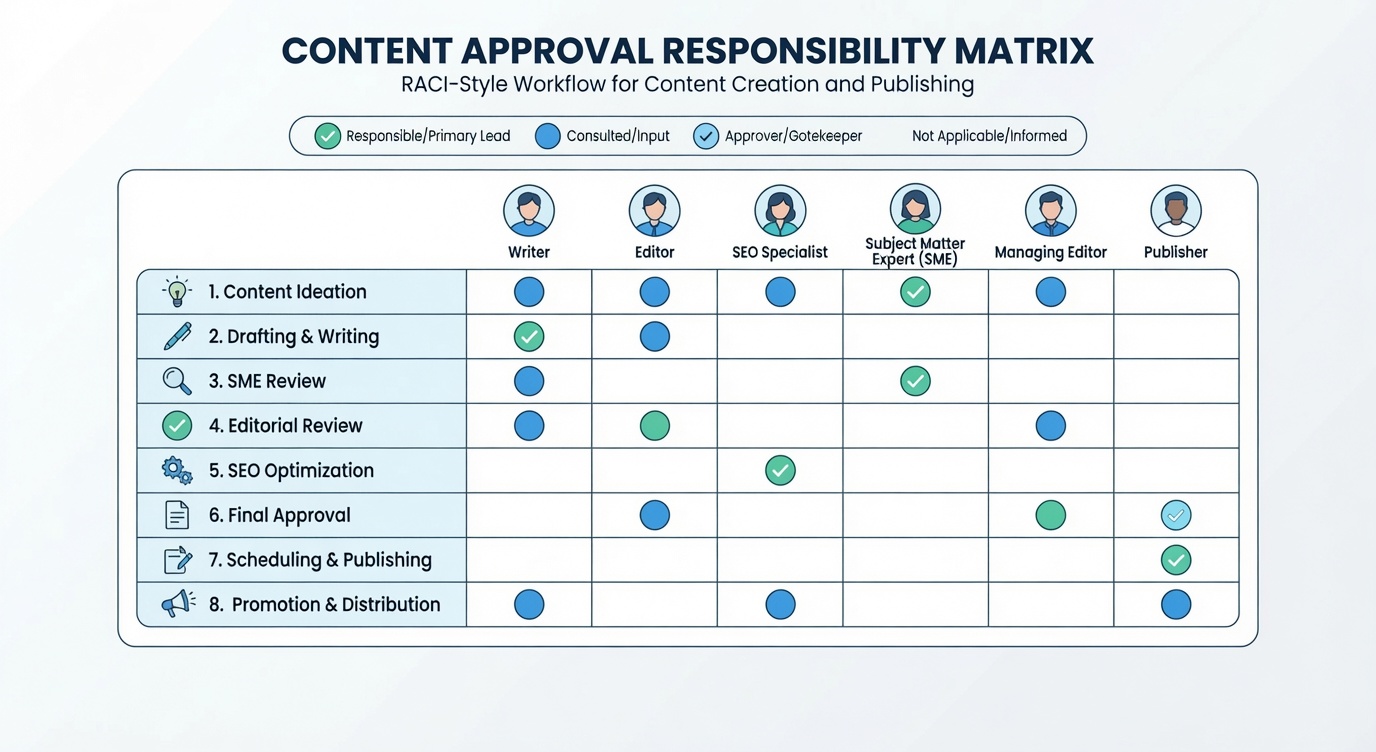
Improving accountability. Without a defined workflow, it's often genuinely unclear who's supposed to approve what. A documented process fixes that by assigning clear ownership to each review stage. When everyone knows what they're responsible for, content simply moves faster.
Supporting scalable publishing. A process that works fine for two writers rarely holds up for twenty. A structured approval workflow lets an organisation ramp up content production without losing quality or visibility along the way. Instead of leaning on memory or ad hoc conversations, every article follows the same predictable path from draft to publication.
Common Approval Bottlenecks
Plenty of organisations invest in better writing processes and still find themselves stuck at the approval stage. Recognising the usual culprits is the first step toward fixing them.
Too many approvers. One of the most common mistakes is looping in everyone who could conceivably have an opinion. Collaboration has real value, but unnecessary reviewers mostly just add delay, and they often introduce feedback that contradicts itself. Only involve people who have a genuine reason to weigh in.
Unclear ownership. If nobody knows whose turn it is to review, the article simply sits there. Every stage of the workflow needs a clearly assigned owner responsible for pushing it forward.
Feedback scattered across tools. Comments in email. Suggestions in chat. Edits buried inside a document. Tasks tracked in yet another piece of software. When feedback lives in five different places, writers end up spending more time hunting for revisions than actually making them. Centralising feedback in one place cuts through that confusion and keeps everyone working from the same version.
Last-minute reviews. Waiting until the deadline to request approval creates pressure nobody needs. Reviewers do their best work when they have enough time to actually think, so building review time into the editorial calendar keeps approval from becoming a recurring fire drill.
Undefined approval criteria. Sometimes content gets rejected simply because expectations were never written down anywhere. Rather than leaving approval to personal opinion, it helps to define clear, shared criteria, such as the following:
- Accuracy
- Grammar
- Brand voice
- SEO optimisation
- Legal compliance
- Technical correctness
Standardised criteria make approvals faster and far more consistent from one reviewer to the next.
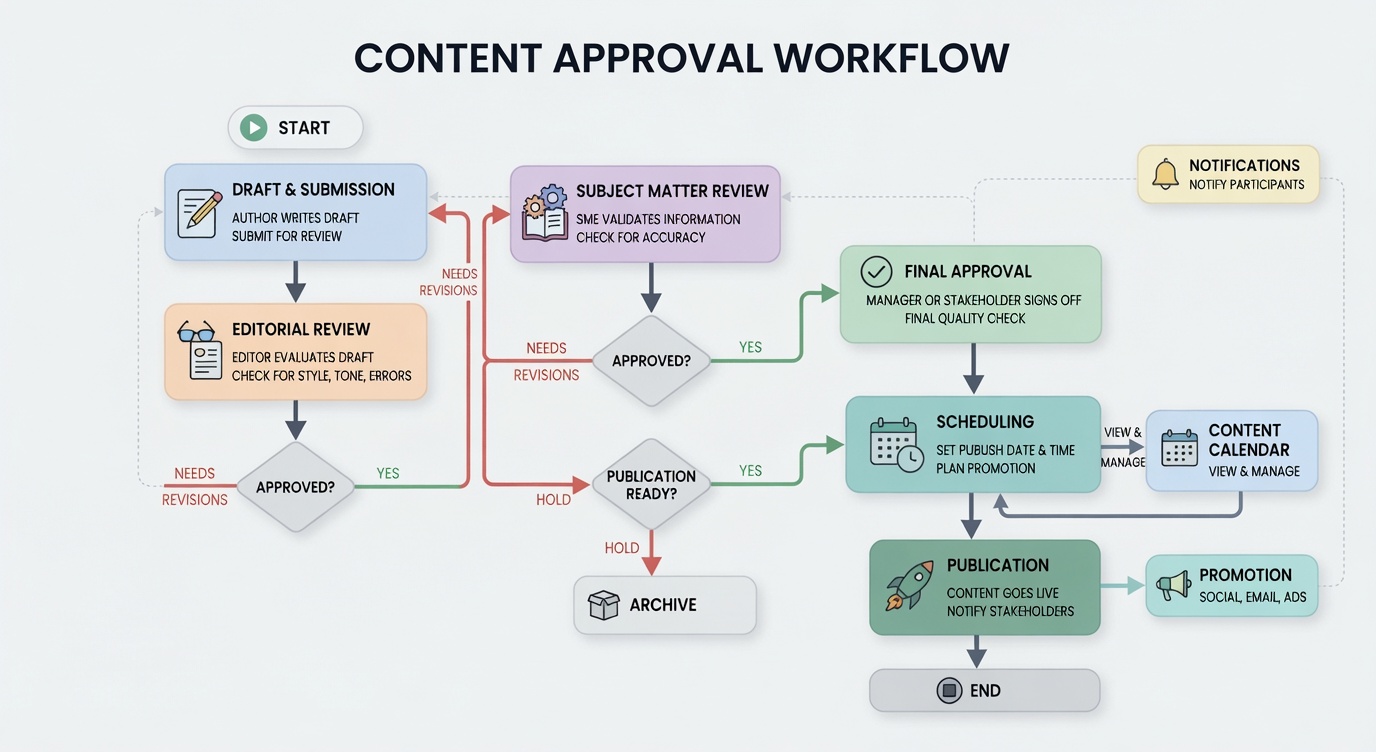
The Stages of an Effective Content Approval Workflow
Every organisation shapes this slightly differently, but most successful approval workflows follow a similar arc:
Stage | Purpose |
|---|---|
Draft Complete | The writer submits the article for review |
Editorial Review | An editor improves structure, clarity, and readability |
Subject Matter Review | An expert verifies technical accuracy |
SEO Review | Metadata, keywords, and internal links are checked |
Compliance Review | Legal or regulatory validation, when required |
Final Approval | The managing editor confirms the piece is ready to publish |
Scheduling | A publication date is assigned |
Publishing | The content goes live |
Not every article needs to pass through every stage. An internal company update might skip subject matter review entirely, while a healthcare publication may require legal sign-off before anything goes out the door. The goal isn't to include every possible checkpoint. It's to include only the stages that genuinely protect quality for that piece of content.
Best Practices for Building a Content Approval Workflow
A good approval workflow balances quality against efficiency. The point was never to pile on more checkpoints. It's to make sure every review that does happen actually adds value.
Clearly define review responsibilities. Each reviewer should know exactly what they're evaluating. Editors focus on readability, SEO specialists review optimisation, and subject matter experts verify accuracy. Splitting responsibilities this way prevents duplicated effort and contradictory feedback.
Limit the number of reviewers. More reviewers rarely means better content. Usually it just means slower publishing and revisions nobody asked for. Keep approval groups as small as they can be while still protecting quality.
Set approval deadlines. Approvals deserve deadlines just as much as writing assignments do. Without one, content can sit in review indefinitely. A simple due date keeps people accountable and publishing schedules on track.
Keep feedback in one place. Writers shouldn't have to dig through five different apps to find every comment. Centralising discussion around the content itself makes revisions easier to manage and keeps a record of past decisions that's actually easy to find later.
Create standard approval checklists. Rather than relying on memory, give reviewers a consistent checklist to work from: Has the article been proofread? Are the claims accurate? Are internal links included? Does it follow brand guidelines? Are images optimised? Is the metadata complete? Checklists build consistency and cut down on things slipping through the cracks.
Track approval status. Visibility is one of the biggest wins a structured workflow offers. Everyone involved should be able to see, at a glance, which stage an article is in, who owns it right now, and what needs to happen next. That kind of transparency eliminates most status-check meetings and follow-up messages before they ever start.
When Should Teams Automate Content Approvals?
As organisations publish more, coordinating everything by hand becomes harder to sustain. Automation can take a lot of the repetitive administrative load off editorial teams' plates, all without replacing human judgement.
Teams commonly automate things like:
- Review notifications
- Deadline reminders
- Workflow stage changes
- Assignment routing
- Publishing schedules
- Status updates
But automation should support decision-making, not replace it. Editorial quality, strategic direction, fact-checking, and legal review still call for real human expertise. The organisations that get the most out of automation use it to handle the repetitive work while keeping the actual editorial decisions firmly in human hands.
Choosing Software for Content Approval Workflows
Small teams can often get by with spreadsheets or general-purpose project management tools, at least for a while. But as a publication grows, it usually needs software built specifically for editorial collaboration.
When you're evaluating content approval software, look for capabilities like the following:
- Custom workflow stages
- Role-based permissions
- Inline comments
- Version history
- Approval tracking
- Notifications
- Editorial calendars
- Workflow reporting
The right platform should make approvals simpler, not add another layer of complexity. If you're comparing options, our guide to Editorial Workflow Management Software: What It Is and How to Choose the Right Platform breaks down the features content teams should prioritise.
How Narranta Supports Content Approval Workflows
Narranta was built to help content teams manage approvals as part of a complete editorial workflow, rather than as a set of disconnected tasks bolted onto the process. Teams can define custom workflow stages, assign reviewers, track approval progress, and collaborate around the content itself, all from a single, centralised workspace.
Instead of juggling multiple disconnected tools, writers, editors, and reviewers work within one shared publishing process that gives everyone visibility into every stage of the content lifecycle. By cutting down on manual coordination and improving transparency across the board, teams end up spending less time managing approvals and more time actually creating content worth publishing.
Building an Approval Process That Scales
A truly effective content approval workflow isn't about adding more review stages. It's about making sure the right people review the right content at the right time.
As publications grow, structured approvals stop being a nice-to-have and become essential for maintaining quality, accountability, and publishing consistency. Organisations that clearly define responsibilities, centralise feedback, and build predictable approval processes are simply better positioned to scale their content operations without running into unnecessary bottlenecks along the way.
Whether you're publishing a handful of articles a month or running a large editorial team, investing in a well-designed approval workflow gives your content operation a stronger foundation for long-term success.