

Most content teams don’t fail because they lack ideas.
They fail because ideas get stuck.
A draft sits in Google Docs waiting for feedback. Someone says “I’ll review it tomorrow” and disappears. A Slack thread becomes the place where decisions go to die. Meanwhile, the publish date quietly passes.
And somehow, nobody is fully sure where things broke.
That’s usually where the problem actually is — not in writing, but in the lack of a clear editorial workflow.
Whether you manage a company blog, a digital publication, a newsroom, or a content marketing team, an editorial workflow helps bring structure to content creation and ensures every piece moves smoothly from concept to publication.
Read more on: Editorial Workflow for Teams: Why It Breaks and How to Fix It
In this guide, you'll learn what an editorial workflow is, why it matters, the common stages involved, and how to build one that scales as your team grows.
What Is an Editorial Workflow?
An editorial workflow is the structured process a team follows to plan, create, review, approve, and publish content.
It defines how content moves through each stage of production and clarifies who is responsible for what along the way.
A typical editorial workflow answers questions such as the following:
- Who proposes content ideas?
- Who assigns work?
- Who writes the content?
- Who reviews and edits it?
- Who approves it for publication?
- When should it be published?
- How is progress tracked?
Without this, teams rely on memory, messages, and “I thought you were handling that.”
And that works… until it doesn’t.
Usually it stops working right when the content volume increases or more people join the team.
Why Editorial Workflows Matter
Many content teams underestimate the impact of a well-defined workflow until problems begin to appear.
Better Team Collaboration
Writers, editors, marketers, and stakeholders all have different responsibilities. An editorial workflow helps everyone understand where content stands and what actions they need to take next.
Instead of repeatedly asking for updates, team members can see progress clearly.
Faster Publishing Cycles
One of the biggest causes of publishing delays is uncertainty.
When teams know exactly what happens after they submit a draft, content moves more quickly through review and approval stages.
Improved Content Quality
A consistent workflow ensures every piece of content receives the same level of review and quality control.
Editors can catch errors, improve clarity, and ensure content aligns with brand guidelines before publication.
Greater Accountability
Clear ownership reduces confusion.
Each stage of the workflow has a designated owner, making it easier to identify bottlenecks and keep projects moving forward.
Better Visibility Across the Team
Managers and stakeholders gain a complete view of content progress without needing to schedule constant status meetings.
This visibility becomes increasingly important as teams scale.
Common Stages of an Editorial Workflow
While workflows vary between organisations, most content teams follow a similar sequence.
1. Content Planning
The process begins with identifying content opportunities.
Teams may gather ideas from:
- Keyword research
- Customer feedback
- Industry trends
- Product launches
- Editorial calendars
At this stage, topics are prioritised and assigned.
2. Content Assignment
Once topics are approved, they are assigned to writers or content creators.
Responsibilities, deadlines, and expectations should be clearly defined before work begins.
3. Draft Creation
Writers produce the first version of the content.
This stage may involve research, interviews, outlining, and drafting.
4. Editorial Review
Editors review the content for the following:
- Accuracy
- Structure
- Clarity
- Brand consistency
- SEO optimization
Feedback is provided for revisions when necessary.
5. Revision
Writers address editorial feedback and make improvements.
Some pieces may require multiple revision cycles before approval.
6. Approval
Depending on the organisation, stakeholders may review the content before publication.
This can include:
- Marketing managers
- Legal teams
- Product teams
- Executive leadership
7. Publication
Approved content is scheduled or published.
Publishing may involve:
- Website updates
- Blog publication
- Newsletter distribution
- Social media promotion
8. Performance Review
Many modern content teams extend the workflow beyond publication.
Performance data such as traffic, engagement, conversions, and rankings can inform future content decisions.
Common Editorial Workflow Challenges
Even teams with established processes encounter obstacles.
Some of the most common challenges include:
Approval Delays
Content often becomes stuck waiting for stakeholder feedback.
Without deadlines or ownership, approvals can significantly slow publishing.
Unclear Responsibilities
When team members are unsure who owns a particular stage, work can be overlooked.
Version Confusion
Multiple document versions create uncertainty about which draft is current.
Communication Gaps
Important feedback scatters across email threads, chat platforms, and project management tools.
Lack of Workflow Visibility
Managers struggle to understand where content stalls and why they miss deadlines.
Our guide on Content Workflow Bottlenecks: Causes and Fixes for Teams discusses many of these issues in greater detail.
How to Build an Effective Editorial Workflow
A successful workflow balances structure with flexibility.
Define Clear Roles
Every participant should understand their responsibilities.
Common roles include:
- Content Strategist
- Writer
- Editor
- Reviewer
- Publisher
Clearly defined ownership helps prevent delays and confusion.
Standardize Workflow Stages
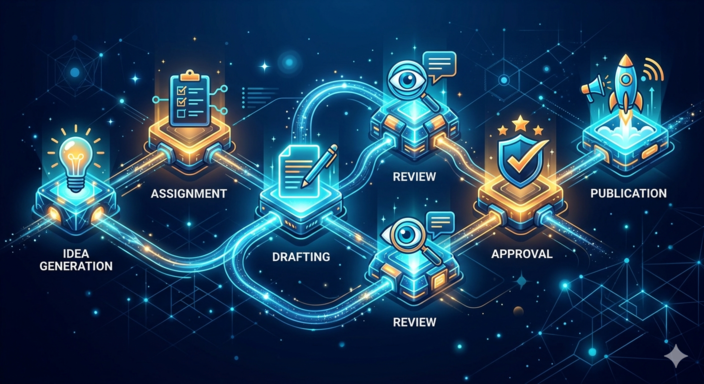
Create consistent statuses that every piece of content follows.
Examples include:
- Planned
- Assigned
- Drafting
- In Review
- Revision Needed
- Approved
- Published
This provides visibility across the entire team.
Establish Approval Criteria
Reviewers should know exactly what qualifies content for approval.
Documenting expectations helps reduce unnecessary revision cycles.
Centralize Communication
Feedback should be stored alongside the content whenever possible.
Centralised communication reduces misunderstandings and prevents information from becoming fragmented.
Measure Workflow Performance
Monitor metrics such as the following:
- Average production time
- Approval turnaround time
- Number of revisions
- Publishing consistency
These insights help identify opportunities for improvement.
Editorial Workflow Example
Consider a SaaS company's content marketing team.
The workflow might look like this:
- A content strategist identifies a topic.
- Writer creates the first draft.
- Editor reviews and requests revisions.
- Writer updates the article.
- The marketing manager approves the final version.
- Publisher schedules the article.
- The content is distributed through newsletters and social channels.
Each stage has a clear owner, making it easy to track progress and identify bottlenecks.
Editorial Workflow vs Editorial Calendar
These terms are often confused, but they serve different purposes.
An editorial calendar defines what content will be published and when.
An editorial workflow defines how content moves from idea to publication.
Think of the editorial calendar as the publishing schedule and the editorial workflow as the operational process that makes the schedule possible.
Both are essential for effective content operations.
When Do Teams Need Editorial Workflow Software?
Simple workflows can often be managed with spreadsheets and shared documents.
However, as teams grow, these methods become difficult to maintain.
Organisations typically begin looking for workflow software when they experience the following:
- Multiple writers and editors
- Frequent approval delays
- Growing content volume
- Difficulty tracking progress
- Communication breakdowns
Dedicated workflow platforms provide visibility, collaboration tools, and structured processes that help teams scale efficiently.
The Path to Improved Content Operations
An editorial workflow is more than a checklist.
It is the operational framework that enables content teams to collaborate effectively, maintain quality standards, and publish consistently.
Without a defined workflow, teams often encounter missed deadlines, approval bottlenecks, and communication challenges.
By establishing clear stages, assigning ownership, and creating a structured review process, organisations can build a workflow that supports both current needs and future growth.
As content operations become more complex, investing in a well-designed editorial workflow becomes one of the most effective ways to improve productivity and publishing consistency.